
Lauren Black On Leveraging Technology And Partnerships To Scale Social Impact Effectively

Lauren has spent 10 years working on Gadigal land at the intersection of technology and social impact.
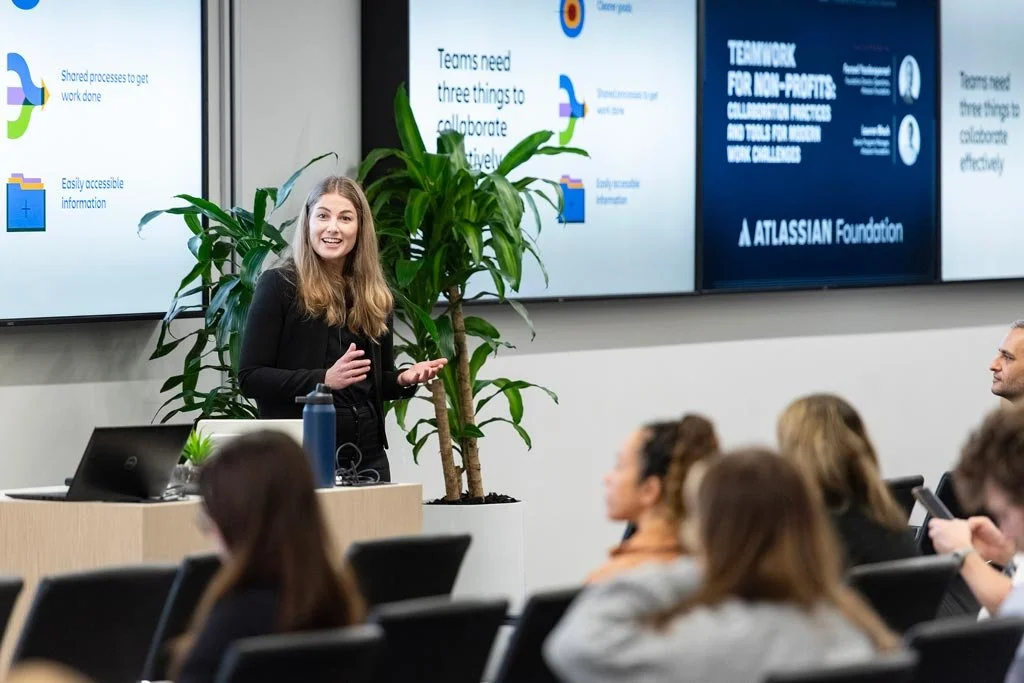
She is a Senior Program Manager for Atlassian for Nonprofits, an Atlassian Foundation program providing discounts and support to nonprofits to help them adopt teamwork collaboration tools and practices.
Her role involves strategic planning, program delivery and impact evaluation as well as deep engagement of nonprofits, social enterprises, employees and partners.
Prior to joining Atlassian, Lauren managed gender equity programs at the University of Technology Sydney and Tata Consultancy Services.
Lauren discusses leveraging technology to enhance efficiency for nonprofits and social enterprises, building strategic corporate partnerships, and why focused leadership and collaboration are key to scaling sustainable impact.
Highlights from the interview (listen to the podcast for full details)
[Tom Allen] - To start off, can you please share a bit about your background and what led you to working across technology and social impact?
[Lauren Black] - Social impact was always very intentional from when I was young and deciding what to do at university. Technology was a happy accident, and I’m very grateful to have landed there. I do love my role and my team.
When I went to university, I wanted to learn about the world, so I studied international relations, but I also knew that I had to get a job at the end of it, so I added commerce. I also did a lot of volunteering with Amnesty International and a couple of other organisations working on modern slavery. There, I learned practical skills around project management, marketing, and communications.
When I went to enter the industry, there were so many nonprofits doing amazing work, but I wanted to start building financial independence. I looked into corporate social responsibility and was lucky to land an entry-level role at Tata Consultancy Services, which is a big global IT company with a longstanding CSR program.
I managed gender equity programs there, working with the head of corporate social responsibility, and I learned so much about authentic social impact. That led to a role at the University of Technology Sydney, where I continued managing gender equity programs, but from more of a nonprofit and university perspective.
Being part of a university was amazing because they focused on evidence-based practice, research, and monitoring and evaluation. Those foundations in social impact I was very lucky to have very early on, and then that led to my role at Atlassian.
What are you learning at Atlassian Foundation, and what are your current focus areas and future plans?
It’s an exciting time at the Atlassian Foundation. We’ve just launched two new discounts for nonprofit and social enterprise customers.
Atlassian for Nonprofits is our program that supports organisations through programs, grants, and resources, and it’s growing every day as nonprofits and social enterprises realise they can be more efficient and effective by using the right teamwork tools.
We’re talking about work management, knowledge management, and video recording tools. If organisations use the right tools, they can spend a lot less time on admin and more time working with their communities and focusing on their mission. That’s what my team and the foundation are focusing on at the moment, and it’s very exciting work.
What kinds of team management tools are you referring to, and how do these tools create efficiencies?
The longest-standing tool at Atlassian is called Jira, and it’s a work management tool. You can imagine that a lot of nonprofits manage projects in spreadsheets, and it can be difficult to keep track of who has been working on them and what changes have been made. It’s also hard to collaborate effectively with teammates.
Often, this leads to a lot of meetings where teams go through each item, which means you spend so much time discussing work updates rather than actually doing the work and interacting with your community.
There is also a huge amount of potential for automation, and now AI is built into these tools. For example, if you have a piece of work and you’ve done something similar in the past, AI can suggest all the different tasks you might need to complete because it recognises patterns from previous work.
From my experience running programs, so much of that work is repeatable, so removing that heavy project management burden is incredibly helpful.
What advice would you give to social enterprise and nonprofit leaders seeking strong partnerships and funding?
As someone who has been through that process while at the University of Technology Sydney, I know that finding funding is hard.
What I’ve learned along the way is that finding the right partner is incredibly important.
Just because a business partner has funds that doesn’t mean they’re the right fit for you. The way I think about it, particularly in corporates where I have the most experience, is to find a partner whose core business is also valuable to you. It’s not just about the money; it’s also about the institutional knowledge and capabilities that organisation can provide.
In the case of Atlassian, it’s teamwork. We’re experts in teamwork, so if you’re looking to transform how your teams operate, you can leverage that knowledge and expertise. We’ve had some amazing partners like Humanitix who have dived headfirst into the partnership and really made the most of it.
What traits have you observed in impactful, purpose-led leaders and entrepreneurs?
The tricky thing about the social impact space is that there’s so much to solve. The problems are so big and complex. Even for us, we run into challenges with maintaining focus, prioritising, and being clear on the specific problem we’re trying to solve.
So much of strategy is about what you don’t do, and I think this ties back to funding.
It’s much easier for a funder to support you and form a partnership if you have a clear focus. When it feels like you’re doing a bit of everything, it becomes really hard to find alignment.
Another thing I’ve noticed, particularly during my time at the University of Technology Sydney, is that there are often many organisations working within the same space, such as gender equity in STEM. There are lots of opportunities for collaboration, and in some cases, those collaborations are incredibly fruitful because there is strong alignment.
In other cases, however, they can become a distraction.
Collaboration is incredibly important, and we have this superpower in the social impact sector in that we’re not competing with each other. There are enough problems for all of us to solve! However, it’s critical to find the right partners to collaborate with, those who are aligned with your focus and goals.
What do you think is holding back the ‘business for good’ movement from becoming business as usual?
This was a tricky question to think about, and I’ll tackle it in two parts.
On the corporate side, I think there has been huge progress. A lot of large companies now have social impact teams, but it really comes down to leadership. The impact of having founders and CEOs, like Scott and Mike who started the [Atlassian] Foundation very early on, means that social impact is embedded and sustained over time.
For example, when we wanted to launch new discounts and took the business case up the chain, both Scott and Mike were involved at different stages and gave their support. If you have leadership that doesn’t support impact, or only supports it during good business periods, then that movement won’t be sustained or scaled. Leadership on the corporate side is incredibly important.
On the social entrepreneurship side, one of the biggest challenges I’ve seen is financial sustainability and security.
It takes a long time to build a viable business, and while there are so many incredible leaders in the space, they also need to be able to support themselves. There needs to be more financial backing to provide security so social entrepreneurs can continue pursuing their ventures.
Where these two areas intersect is in leadership on the funding side, ensuring that financial support exists to enable social entrepreneurs to succeed.
What inspiring projects or initiatives have you come across recently creating a positive social change?
I’ll start with some of our peers in the tech sector, and hopefully nonprofits and social enterprises listening can explore their programs.
Okta, a security tech company, has recently started a collaboration with TechSoup called the Virtual CTO. What’s great about this is that nonprofits can pay a membership fee and gain access to a CTO who can help them build their tech roadmap. When I was leading a skilled volunteering program, we had so many requests for this kind of support, because organisations don’t want to invest in new technology only for it to be underutilised. It’s a really incredible initiative and collaboration from Okta.
Twilio is another tech company doing great work. Their software supports communication via text and email, and they offer a discount program similar to Atlassian. Their tools enable organisations, particularly those working in disaster or crisis response, to communicate effectively with their communities.
On the partnership side, we have a strong collaboration with Goodstack. They’ve enabled tech companies to scale their technology-for-good programs by handling the verification process, which now includes both nonprofits and social enterprises. This has allowed us to expand our discounts more broadly, and organisations can register directly on their platform, making the approval process much more efficient.
To finish off, what books or resources would you recommend to our audience?
One book I’ve read recently, which our whole foundation team is reading as part of a little book club, is Technology for Good by Jim Fruchterman. It resonated with me because it explores the learnings and failures of implementing technology in the nonprofit sector.
If you’re a founder building a tech-focused nonprofit or social enterprise, or even if you’re simply looking to implement technology more effectively, it’s a great resource outlining what to do and what to avoid. It’s a relatively light read, but very well researched, and the author brings a lot of experience in this space.
Another book I always recommend is Dare to Lead by Brené Brown. It’s more sector-agnostic, but highly relevant for social impact leaders. Her framework around brave and daring leadership comes up time and time again.
In the social impact space, you often face setbacks, and the ability to lead with empathy and strong interpersonal skills is critical. The more we can show up in that way, the more effective we’ll be.
Recommended books
Technology for Good: How Nonprofit Leaders Are Using Software and Data to Solve Our Most Pressing Social Problems by Jim Fruchterman
Dare to Lead: Brave Work. Tough Conversations. Whole Hearts. by Brené Brown



On Episode 641 of Impact Boom, Shannon Lemanski of Aqua Ubique discusses how atmospheric water generation technology addresses water insecurity, building community-led solutions with First Nations communities, and why financially sustainable social enterprise models are essential for scaling long-term impact.