
Alison And Jan Schutt On Empowering Community And Education Through Second-hand Stationery
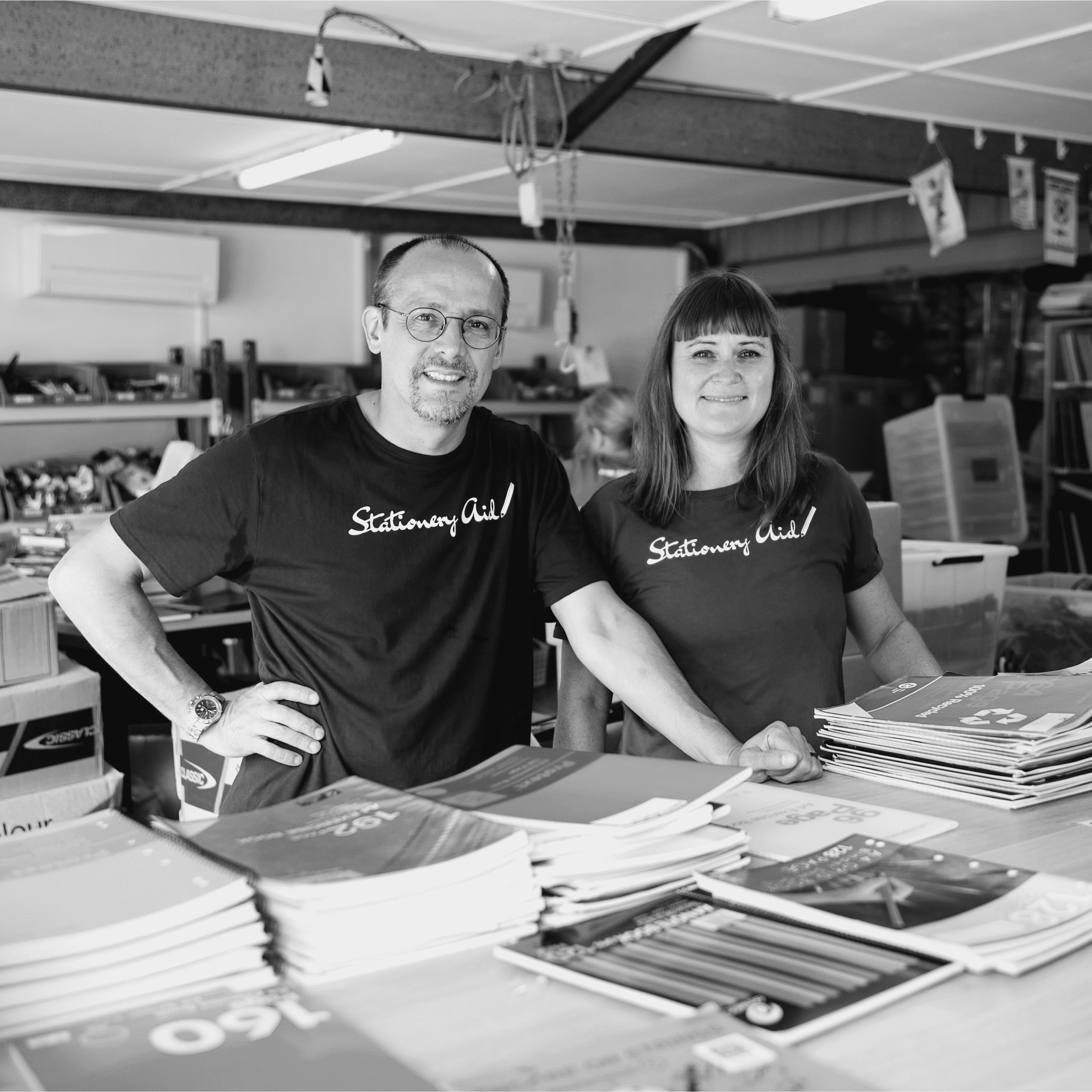
Alison Schutt has a background in applied science - environmental health and sustainable product design.
For over 20 years she has been a director of her sustainable design studio Haasch Pty Limited and has also worked in the public and private sector practicing environmental health with expertise in infectious diseases of environmental origin, waste management in particular circular economy, food safety, infection control, education for sustainability, drinking water and wastewater management, chemical hazards and disaster response.
Respect and responsibility for biodiversity and our planet; compassion, empathy, inclusion and equality for all people regardless of their background, led to her work with Stationery Aid.
After schooling in Geneva, Switzerland and Bristol, Jan Schutt received a Bachelor of Science Honours in Business Studies at Roehampton Institute, Surrey University.
Currently the General Manager of an iconic hotel in Brisbane, Jan has worked in the hospitality industry since university, working in Geneva, London, Sydney, Hunter Valley, and Brisbane.
Jan and Alison’s goal to achieving a more sustainable society whilst creating a supportive community, especially in education, led them to found Stationery Aid.
Stationery Aid is a not-for-profit providing environmentally sustainable educational supplies that ensure inclusion, equity, and positive learning outcomes for all students, regardless of background. Stationery Aid delivers complete booklist and stationery packs to disadvantaged students, helping them feel included, prepared, and able to participate in learning. Their circular economy model reduces landfill by renewing, reusing, and recycling school supplies—diverting over 80 tonnes from waste streams to date.
Alison and Jan discuss how interconnected impact can be across social inclusion, education, and the environment, and the importance of exploring and contributing to your community.
Highlights from the interview (listen to the podcast for full details)
[Emma Dimech] - Could you both expand on what led each of you to working in waste reduction and social inclusion?
[Alison Schutt] - I grew up in a small country town in Central Queensland, and I’ve always wanted to do almost everything. I had lots of passions, loved people, and I loved the environment. I was doing National Tree Planting Day in the late eighties when it first existed. I loved the arts as well, particularly design.
When I finished school didn't know what I wanted to do or which direction to go in. My parents heavily guided me towards focusing on environment, so I went into applied science environmental health. Going into it, I wasn’t sure exactly what it was going to be, but in essence it's anything in the environment that affects human health and wellbeing. Without environmental health, there is no human health.
Shortly after that, because of my love for the arts, I studied furniture design, design for education, and sustainable design, which led us to found Haasch.
In the early 2000s, we were using some materials from Reverse Garbage, but mostly industrial discards. We had to think creatively to make these products look brand new because in those days it was very uncool to use something that looked recycled.
We really had to think outside of the box and innovate on what we were doing. We called our kind of work innovations in sustainable design, and, for me, that is how Stationery Aid is an evolution of all our learnings, culminating in stationery, education, social impact, and environment today.
[Jan Schutt] - For waste reduction, I’m not as immersed as Ally, but I've been very fortunate over the years to have lived in some beautiful countries, especially from an environmental perspective. From France, Switzerland, the Alps, and the natural environment we have here in Australia, which has some amazing diverse ecosystems.
It’s always been very important for us to look after the beautiful environment we live in. One of those first steps is reducing the amount of waste that goes into it. Tying that in with what Ally said about design, which I do love from an architectural and product design point of view, you need to look after one if you're going do the other. That’s why waste reduction is close to my heart.
Regarding social inclusion, over the years I’ve wondered about what I can actually do to help people.
Can you give money to people to help them out? That can be hard if you're struggling yourself and not earning top salaries. You can give a little bit, but is that enough? You never really know where to start at first.
Stationery Aid really just fell in our lap. Six years later, you turn around and see what you've actually achieved and it shows it's actually not that hard to go out and find a purpose, and to help other people and the environment.
[Alison Schutt] - It's exciting. It's simple and it works, and that's what we love about it.
Could you share more of Stationery Aid’s founding story and how it is able to support disadvantaged students?
[Jan Schutt] - I love telling a story. My first role in impact was as a member of Lions Club International, not to be confused with the AFL Lions team we have here in Brisbane. The Lions Services Club is an amazing organisation with the motto "we serve." A lot of the work they do is fundraising, but they also do a lot of disaster and medical support, so it’s really diverse. I became a member about seven years ago, and I’m currently the president of the Metropolitan Lions group here in Brisbane.
We have two sons, they're eighteen and twenty now. When they were going through primary school, we would order a book list with all the necessary stationery for the next year around September or October. It was easier with some of the schools to just tick the box for everything. You'd order it all and that would arrive before the end of the year. Then, as the school year finished, the boys would come home with the previous stuff they had used throughout the school year.
Some of the stationery was half used, but most of it was perfectly good. It’d be a pair of scissors that was a little worn, maybe a bit dirty, a glue stick that was half used, rulers, pencils, or coloured pencil sets where maybe a colour was missing. We would order four exercise books and they'd have used two completely, while another one of the books maybe only had one page written in while the last one was unused.
Our sons would bring all of this stationery back, and obviously being environmentally conscious, we couldn't bring ourselves to throw good stationery away. We put it in a drawer somewhere and would say, "We'll use it next year," but of course, we had already bought the stuff for next year.
The following year we’d realise the exercise books were now not suitable, the lines have changed. They've progressed onto something else. By the time they got to high school, there was no need for coloured pencils, scissors, or glue sticks.
I brought the stuff out and, being German and a little pedantic about order, I decided to organise it all into separate groups. I went online to see if I could find a charity or an association that would take this perfectly good stationery, but nobody at the time would take used. It was either new or money.
I gave it to Ally to throw out. She put it in the back of her car and off she went. Twelve months later, I borrowed her car for the day, and I opened the back of the car and found the stationery still sitting there. She couldn't bring herself to throw it out. I said to her, "Ally, we've got to do something about this," and I reflected on one of my colleagues in Lions, who was one of the founding directors of Foodbank Queensland.
I said, "David, he would've started a charity to sort this out, like Foodbank." Ally replied "Well, we've got the expertise and the knowledge, why don't we?"
That was over six years ago. We started by doing a little pilot study of how we could go about it. In essence, Stationery Aid collects used and unused stationery from various sources, and then we sort it, clean it, sanitise it, and make it as new as possible,
[Alison Schutt] - It needs to look new. That's the important thing. In order for us to pass it on, it's got to meet our standard here. If it's in good condition and used but doesn't quite meet our standard, we pass it on to charities that work overseas, but regardless it still needs to be in good condition.
[Jan Schutt] - We pack the stationery into book lists and give it to children who go without. Since the problem came from book lists, we thought that giving a child what they need for the full twelve months was the better solution. Giving a child just a pencil and a notepad is not going to help them study geography or mathematics
We also provide for both primary and high school, and we want to ensure that the child receives everything that the child beside them is getting. The stationery needs to look new, and they need to have everything for that school year. If we have to purchase additional items to make sure we have a full book list, that's what we do.
That's how we’re supporting those who are disadvantaged. We do that work through a variety of charities and associations who work with us, both for the collecting, sorting, and cleaning, and the distribution as well.
[Alison Schutt] - Our community partnerships are crucial. We do more than just run Stationery Aid, we empower students in primary schools to be involved and to create social environments. The sustainability leaders love Stationery Aid. We teach them kindness, compassion, empathy, and environmental sustainability, and that's by running fundraising campaigns for our book lists.
Our high schools are teaching civic engagement via active volunteering. They are part of our circular economy program where they renew resources. We have other charities that we work with as well, like Brisbane Women's Correction Centre and Youth Justice, so we have a community network of partners that help us create positive outcomes.
Anyone can be involved at any level, and I think that's why it works. We also started at the beginning of COVID, when people weren't allowed to volunteer in aged care or go outside of their school. We took civic engagement volunteering to them and it actually works.
Over the six years you’ve been running Stationery Aid, what have been some of the biggest challenges you've had to overcome and some of the key learnings?
[Alison Schutt] - Our challenge has been our rapid growth and the demand for our services.
We were one family in a situation knowing that there would be thousands of other parents and guardians in the same situation with supplies at the end of the school year.
The solid waste from school stationary supplies is in excess of two hundred and seventy-six tonne annually. That's a conservative estimate of what goes to waste. At the moment, we collect between ten and twelve tonnes, so we're only just touching the surface of what we can actually achieve.
If we collected more, that entire two hundred and seventy-six tonne, we would be able to support fifteen thousand students in Queensland schools that need support. There are approximately ninety-six thousand that live below the poverty line in Queensland alone, and there's the bottom four percent, which is about twenty-three thousand kids, that are missed by the system and they turn up to school without.
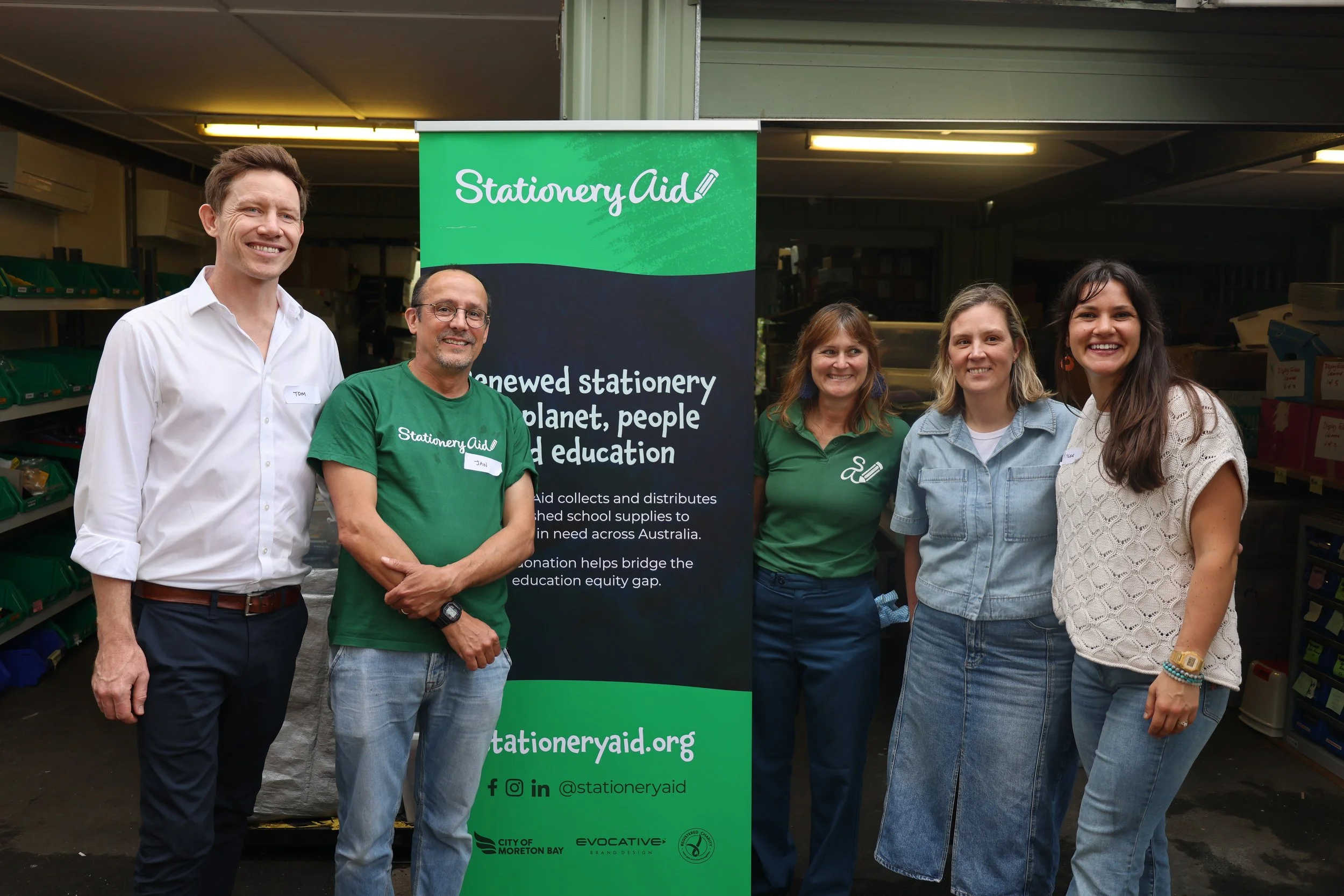
The huge need is our challenge. We've had to push back on the demand for our services, and we haven't been able to promote what we do as it would collapse us because of our storage limitations.
We are finally moving into expansion as we now have the funding for a lease, which means we can now bring in more supplies. Space has been a critical limitation, as well as paid skilled people. We have ample volunteers that help us both regularly and casually, and we have our community partnerships, but the next steps need a paid team.
[Jan Schutt] - From a people perspective, a lot of great charities and ideas start up and directors get burnt out after three years. That’s usually seen as the turning point that charities and businesses in general have to get past. If you can get the support of people and funding and whatever else, it helps get beyond that.
You want to do so much, and you do so much, but you need to look after yourself first before you can look after other people and other systems. A lot of people try to do too much and burn themselves out. Make sure you have people to support you and good teams to fall back on.
[Alison Schutt] - We're up to six years now, so we're past the five-year mark as well.
The expansion feels like a breath of fresh air. South Brisbane will also open up our opportunities for skilled labour and different volunteering cohorts from the south side of Brisbane.
We’ll be able to pack book lists in comfort during our busiest time of the year for our volunteers. We now have to fit it out, set up, and open. Hopefully mid-August, if not, it'll be mid-September.
What advice would you give to aspiring changemakers looking to start their impact journey?
[Jan Schutt] - If you want to do something, rather than starting a charity, go and see what's out there first. See if there's a charity that you can support, or a group you can support, rather than add to the charities already are out there.
A lot of the time there is something out there that needs additional help, but sometimes, like in our case, there is nothing there, so we did have to start something. Take a look and think about what you want to do and what expertise you have.
You don't always have to look at bigger charities. Every charity needs help in various different ways. Sometimes it's the smaller charities that whilst they might not be recognised, probably need more help.
If a small charity connects with you, get in there and help them out. Give them the expertise you have. Everybody has something, some knowledge or skill that is transferable into another area. Charities are looking for people with social media, accounting, and creative expertise; There is always something you have that you can give.
[Alison Schutt] - If you find a problem, act on the problem. Take action if there's no one else doing it. If you help one component in an area where there is need, you're doing good.
[Jan Schutt] - If you don't know what you want to do, join some of the big service clubs like Lions or Rotary. They're very well spread in the different things they do. There's lots of Lions clubs that you'll find are doing more weekly things, so you might find there's more retirees or people who are not working throughout the week. There's a lot of younger clubs as well for people still in the workforce who may only have time on the weekend or after hours.
When you go into those sorts of environments, you don't know what you might be doing. Some are simple, like cooking sausages outside Bunnings to raise money for a whole variety of different needs.
What inspiring projects or initiatives have you come across creating a positive social change?
[Alison Schutt] - We have a spectrum of inspiring stories and people that we work with every day. I would say the number one has to be Officeworks. Officeworks don't overly share what they do and how much they give to community, but their Bring It Back stations have been a big supporter and advocate of Stationery Aid. They believed in us in our early days, and our values align. They're a big corporate citizen, but they do so much good stuff. It’s just blown me away. We are eternally grateful for their support.
Out of the charities we work with, there’s one in particular called Commonkind. It started at the same time as Stationery Aid and they empower young people by teaching them philanthropy at a very young age with their families. They create Art With Heart programs and we donate our excess craft to them. In return, they provide us with beautiful pieces of art, cards, and amazing little activities they do within the community.
Lions International, their programs have opened my eyes with how they work across community. Jan explained some of it earlier, but one thing they do is collect the little tokens off cans and send them away to be melted down. There're so many different program areas across environment and social impact in Lions.
The number of schools that empower students by teaching them social, environmental, and educational impact, at such a young age is incredible. High schools doing active volunteering is ever growing.
The Duke of Edinburgh program is, in a lot of high schools, teaching civic engagement and community responsibility.
Another is The Funding Network, which I feel like in the last three months we've become part of a family that is professionally teaching us so much in the sector. They support us and grassroot charities as a whole, and they're doing amazing things across the country.
There’s also Impact Boom, of course. It’s only been two months and the support we've had is enormous as well.
[Jan Schutt] - I think Ali nailed them all. She got all the names in there, but it's especially the stories behind all of them that stand out to me.
Some of the most inspiring stories are not from people who are sitting around trying to find something to do. They're some of the busiest people, both individuals and groups, that seem to find time in a non-existent day to go out and do things. Even through adversity, they find the time to be able to give.
I tell anybody listening to go out there and find a charity or initiative you’re curious about and find out how they did it. There are some amazing stories out there with some amazing people, some that are connected to Stationary Aid and some that I’m just passionate about personally.
One of my personal loves is running and Parkrun is a great story from an individual in England who started a movement of health and community all over the world, and there's no money taken from it at all.
It's the stories behind the people who do all these things and the continuation of their journeys. It's now no longer that individual who's doing great things, it's the community getting together and working together to create that change.
To finish off, what books or resources would you recommend to our listeners?
[Jan Schutt] - I mentioned a colleague in my Lions group who was quite motivational to us, but there were two who were inspirational. That’s David Muir and Peter Johnstone, and David has just launched a book called The Long Reach of Service. He grew up in Longreach and was a lawyer by trade, but the book talks about the service he provided in various ways, from the political side of things to Lions.
He's been a member of our Lions group for close to forty years. He was the founding director of Foodbank Queensland and involved in a number of other charities. It's quite inspirational reading about what he did for service outside of his legal career.
For resources, we're fortunate nowadays to have the internet and social media. If you want to do something, go look for it and you can find the answer to pretty much everything out there. If you want to serve or contribute, there are service clubs you can find on social media. There are volunteering sites on Facebook you can join. Use the positive side of social media to find out what's going on out there and get involved.
[Alison Schutt] - In relation to starting a charity or a social enterprise, I would suggest visiting Justice Connect. It’s a not-for-profit legal body which explains everything about setting up social enterprises and not-for-profits.
The Institute of Community Directors is another amazing bank of resources. I did my research through both of those in order for us to set up correctly and properly in the beginning. Both of those two organisations assisted with that work through free public information.

On Episode 639 of Impact Boom, Alison and Jan Schutt of Stationery Aid discuss how interconnected impact can be across social inclusion, education, and the environment, and the importance of exploring and contributing to your community.